Posts mit dem Label Cosy Pièro werden angezeigt. Alle Posts anzeigen

Mittwoch, 3. Dezember 2025

Urning & Urningin. Language and Desire since 1864


URNING AND URNINGIN 

Language and Desire since 1864

9 January – 12 April 2026

Opening: Friday, January 9, 8 - 11 p.m. 


Curated by Philipp Gufler

Artists: Sharan Bala, CAConrad, Philipp Gufler, Eli Hill, KRIWET, Cosy Pièro, Rory Pilgrim, Sophie Serber, Karl Heinrich Ulrichs, Louwrien Wijers


Note: this exhibition takes place in our renewed location at De Constant Rebecqueplein in The Hague.


Love and desire between people of the same sex have existed throughout history. For centuries, there was no language to name these desires–except in medical and legal terms that defined them as illness or crime. This began to change thanks to Karl Heinrich Ulrichs (1825–1895), a German lawyer who was the first to describe same-sex desire as an identity category. Ulrichs conducted extensive research into what he called ‘uranism’, built a network of scholars around it, and argued that queer desire should be recognised as something innate rather than criminal. With his own vocabulary he articulated queer identity long before words such as homosexual, gay, or queer existed.

Ulrichs’ legacy forms the starting point for the exhibition Urning and Urningin. Language and Desire since 1864. The title refers to Ulrichs’ positive description for himself and others with queer desire: Urning and Urningin. He used these words publicly for the first time in his series of pamphlets Riddle of Male-Male Love, published between 1864 and 1880. Before that, queer desires were left unnamed and treated as equivalent to forbidden sodomy in Western society at the time. Ulrichs’ new words were widely used in German at the end of the 19th century and were also adopted in the Netherlands and beyond. Although his terminology did not stick in the current times, Ulrichs’ ideas laid the groundwork for modern queer theory.

In this exhibition, guest curator Philipp Gufler explores the limitations of language–then and now–in expressing desire, and calls for intersectional solidarity. Alongside original documents and letters by Ulrichs, which offer a glimpse into his era and the influence of his thinking, nine contemporary artists have been invited. Through their work, they reflect on themes of (gender)identity, language, and queer desire. Marking the 200th anniversary of Ulrichs’ birth, this exhibition connects past and present, showing how exchange across generations can be both hopeful and transformative.

A publication will be released alongside the exhibition, featuring a pamphlet by Karl Heinrich Ulrichs, visual material by the artists, and newly commissioned texts by Gürsoy Doğtaş, Hendrik Folkerts and Simon(e) van Saarloos. 


Nest
De Constant Rebecqueplein 20-B
2518 RA Den Haag
The Netherlands


Photos: Kyle Tryhorn


Sonntag, 21. September 2025

Gesucht: Werke von Cosy Piéro


Gesucht: Werke von Cosy Pièro


Für einen Film und Ausstellungen über die Münchner Künstlerin Cosy Pièro (1937–2023) bin ich auf der Suche nach ihren Werken.


Die Videoinstallation Remembering Cosy (Arbeitstitel) von Philipp Gufler ist ein experimentelles Porträt über das Leben und Werk der Künstlerin. In den letzten zehn Jahren stand Gufler im engen künstlerischen Austausch mit Cosy Pièro.

Nach dem Studium der Bildenden Künste in Brüssel und einem längeren Aufenthalt in Südfrankreich zog sie zurück nach Deutschland und lebte fortan als alleinerziehende Mutter mit ihrem Sohn in München. Um ihren Lebensunterhalt zu verdienen, gründete Cosy 1962 die legendäre queere Künstler*innenbar Bei Cosy. Dort stellte sie ihre berüchtigte Serie von Zeichnungen aus, die 1963 aufgrund des bayerischen Schmutz- und Schundgesetzes beschlagnahmt und höchstwahrscheinlich vernichtet wurden. Anfang der 1980er Jahre, nach 20 Jahren, übergab sie das Bei Cosy an ihre damalige Partnerin und konzentrierte sich wieder ausschließlich auf ihre Kunst. In den 1980er Jahren schaffte sie großformatige Gemälde, überlebensgroße Skulpturen und raumgreifende Installationen, die sie international ausstellte. Vor allem die Suche nach Werken aus dieser Schaffensperiode aus den 1980er Jahren, die durch Galerien verkauft wurden, stellt sich als schwierig heraus.

Für die geplante Videoinstallation möchte Philipp Gufler Cosy Pièros Arbeiten in privaten Sammlungen und Institutionen filmen. Remembering Cosy entsteht in enger Zusammenarbeit mit Cosys Witwe, in Kooperation mit dem Forum Queeres Archiv München e.V. und soll zusammen mit Arbeiten von Cosy Pièro Ende 2026 gezeigt werden. Remembering Cosy thematisiert Ausschlüsse von queeren und weiblichen Künstler*innen bis in unsere Gegenwart und fragt nach der Hinterlassenschaft der Künstlerin.


Falls Sie Arbeiten von Cosy Pièro besitzen, weitere Informationen über die Künstlerin haben oder sich ebenfalls für ihr Leben und Werk interessieren, nehmen Sie Kontakt mit mir auf:

kontakt (at) philippgufler.de


Abbildung: Cosy Pièro, Auch Erdbeeren zünden, 1984, Holz bemalt, 120 x 80 cm, Unbekannter Besitzer, Foto: N.N., aus: Cosy Pièro: Neue Arbeiten, München: Dany Keller Galerie, 1985

Donnerstag, 19. September 2024

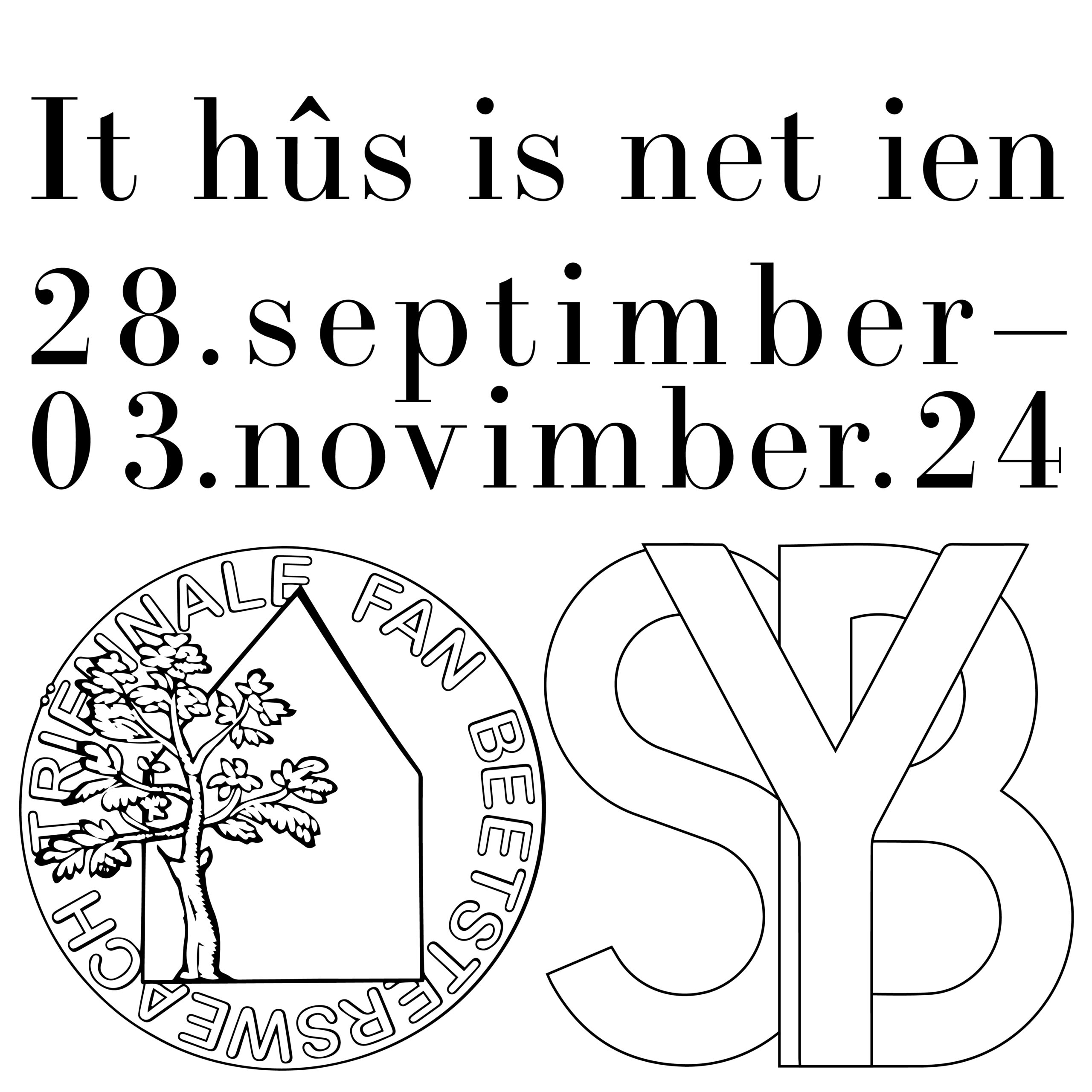
It hûs is net ien


Triënnale fan Beetstersweach


It hûs is net ien

28. septimber – 03. novimber 2024


In which house and with which woman does-did-will love happen? And when is it time for love, anyway? Time for work? How can the stakes in love and work be sorted out?

– Luce Irigaray, ‘This Sex Which is Not One’ (1977)


Kunsthuis SYB invites you to the 4th edition of the Triënnale fan Beetstersweach, from Saturday 28 September to Sunday 3 November 2024. The exhibition takes place in the village of Beetsterzwaag, in the bilingual province of Friesland.

This year’s Triennial is titled It hûs is net ien. This title loosely translates into English as This house which is not one. The exhibition brings together works by the artists who have been in residence at SYB over the past three years and aims to plant the seeds for the 2025-2028 program around questions of habitation. Since it was founded in 2000, Kunsthuis SYB has been a place for research, support and experimentation, a space where artists live and art is made. Conversations are often held around the kitchen table, stimulating connections with the local residents, and in relation to the Frisian landscape and its stories.

In the 1970s, second wave feminism introduced the now famous saying, ‘the personal is political’, to reexamine the prevalent norms and gender positions in society. This edition of the Triennial embraces this principle and proposes it in relation to exhibition making, asking questions such as: What is a house? Who lives in a house? And how does such a personal space relate to the world outside?

The exhibition takes place in two artist houses in Beetsterzwaag, as well as in the Tropische Kas, a garden and greenhouse which was once part of one of the houses in the village. Kunsthuis SYB, Sybren Hellinga’s former home, functioned as a gallery and a ‘schenkerij’ where drinks were served. In line with this, the exhibition takes place throughout the house. A newly commissioned bar is located on the ground floor. Publik Universal Frxnd (fka Richard John Jones) creates an installation inspired by both 18th-century clandestine bars called ‘lolhuizen’ and a 20th-century artist’s bar named Bei Cosy. Here, Pia Louwerens and Katinka van Gorkum present their work inspired by the Anna Blaman House, a place to preserve feminist and lesbian heritage in Friesland.

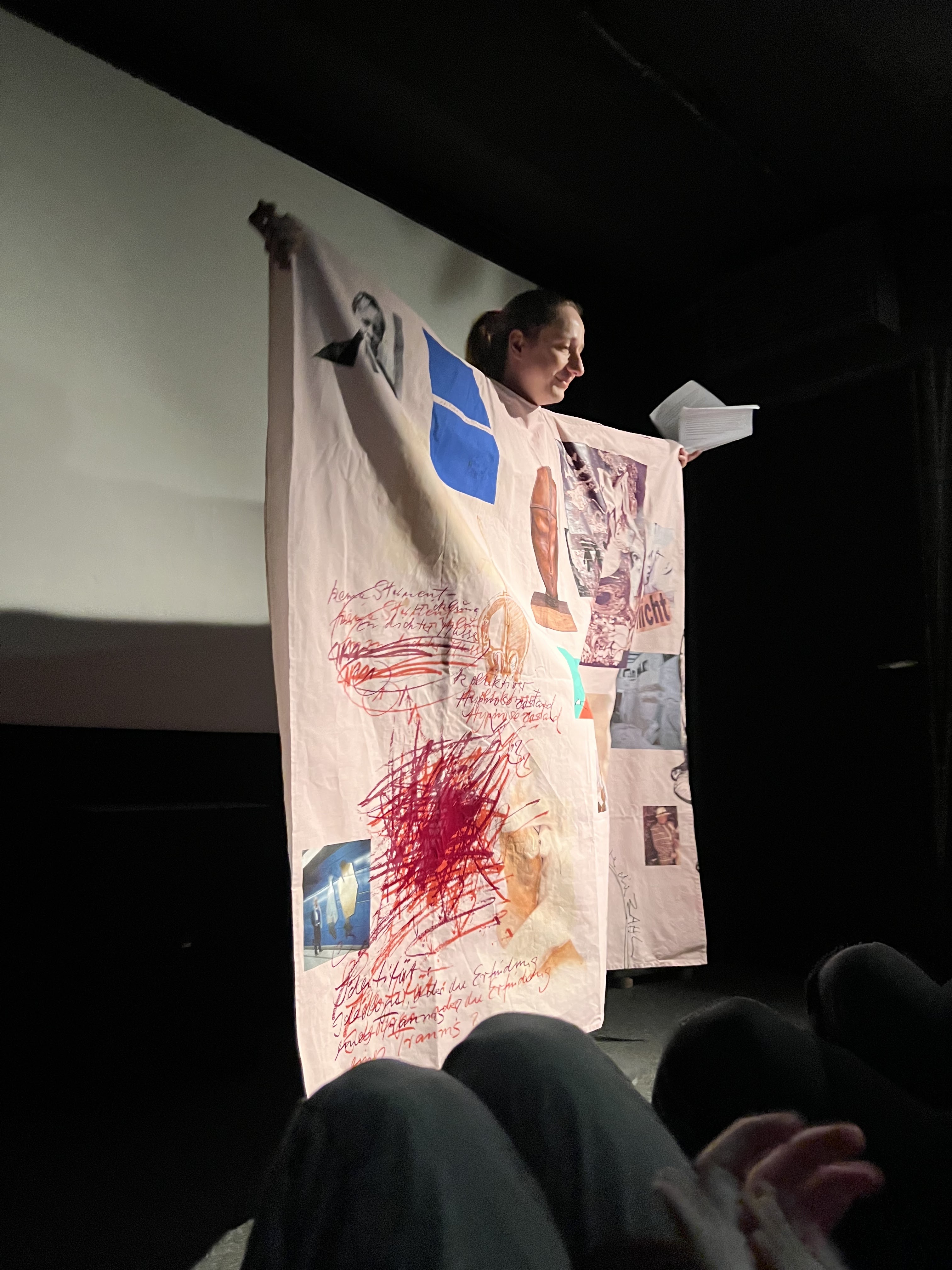
Connections between artists of different generations play an important role throughout the exhibition. For instance, Philipp Gufler pays homage to artist Cosy Pièro’s legacy in a performance and Rory Pilgrim portrays their friend, artist Louwrien Wijers. Attention to intergenerational healing is also present in the works of artists Ola Hassanain and Steven Jouwersma. ‘How to carry a house with you?’ they seem to ask.

Across the street the exhibition continues in a room in the home and working space of artist Eja Siepman van den Berg. Assembled here are works that delve into the surroundings of Kunsthuis SYB. Where Sol Archer dives into the relationship between ecology and colonial imagery, Olivia D’Cruz portrays a changing relationship between people, the landscape and bodies of water. It hûs is net ien mirrors, a world full of tensions, but also a world of wonder, curiosity and kinship between people. A world which inevitably enters the house. A house which is not one.


Curated by Arnisa Zeqo, director Kunsthuis SYB, with associate curator Titus Nouwens.


Saturday 2 November 2024

Remembering Cosy

Artist Philipp Gufler pays homage to artist Cosy Pièro with a new live performance titled Remembering Cosy. The performance touches upon the different aspects of their friendship and collaboration.  The performance questions how to physically carry and make space for queer genealogies and intergenerational dialogue.


Photos: Ernst van Deursen


Kunsthuis SYB (hoofdlocatie)
Hoofdstraat 70
9244 CP Beetsterzwaag

Openingstijden: Vrijdag, zaterdag, zondag 13:00 - 18:00 uur, en op aanvraag

Freitag, 9. Juni 2023

Love Planets


LOVE PLANETS

Philipp Gufler and Cosy Pièro


23 June - 28 July 2023 

Opening 22 June 2023, 6 - 8 pm
with a book presentation of A Shrine To Aphrodite by Philipp Gufler (Hammann Von Mier Verlag, 2023)

What planet do we live/love on? Is love timeless, infinite even? Who loves who or what? Philipp Gufler and Cosy Pièro’s work in the exhibition, Love Planets, at the Galerie Françoise Heitsch revolve around such questions of love in the broader sense of the word.

In Philipp Gufler’s Die Wirrwelt der Urninge (2023), brightly coloured undressed bodies unite in dance and desire against an idyllic mountain backdrop. Those potrayed in this paradise – the Uranians – owe their name to the planet Uranus and a mythological reference: the ancient Greek god Uranus, who has symbolized same-sex love since antiquity.¹ Without a woman’s involvement,, the goddess of love Aphrodite emerged from sea foam made up of Uranus’ fallen body parts. Based on this, Karl Heinrich Ulrichs (1825-1895) coined the term Uranian, even before words such as gay or homosexual dominated language (initially and predominantly with negative connotations). Uranian was completely different, as Ulrichs also described himself as a pioneer of the queer emancipation movement in 1867 in what was most likely the first outing in modern history. Gufler takes a similar, proud stance when he confidently lends his own face to some of the figures in the picture. In terms of form and motif, the screen prints on paper refer to the wall-filling panorama Die Klarwelt der Seligen, which Elisàr von Kupffer (1872−1960) painted in 1925/37 within the context of the religious movement Klarismus. For Philipp Gufler, the mural stands for a paradisical, non-binary imagination of love set apart from categories of difference.²

By referencing the works of certain people of past generations, Gufler pays homage to a Queer Futurity³, which, in addition to Ulrichs and von Kupffer, is also primarily aimed at the second artist in this exhibition: Cosy Pièro. However, her artistic works reflect less on utopian future scenarios, as they are literally
anchored in life: for example, the leather shoes on which she wrote GEHEN LASSEN (letting go) with adhesive letters (2014). In sculptural gestures and with reduced text, such as Potenzial, Pièro negotiates fundamental parameters of human existence: energy, death, love. Everything and everyone have potential, yet contradictions remain. They are abstract, poetic comments on the inadequacies of the present; the political rationalisation of being together, the insistence on gender binaries, the heteronormative understanding of love. Aptly drawn on a deep blue screenprint: Ich liebe nur die Illusion (2012).

The visual artist’s commitment to this present is anything but illusory. With the bar “Bei Cosy”, she created one of the few spaces for the queer community in Munich from 1962 to 1980. In this space as well as in her art the focus was on encounters between people, regardless of age, origin, gender, and sexuality; an attitude that is particularly impressive in times of identitarian demarcations. Attracted by this, Philipp Gufler realised a re-enactment of the “Bei Cosy” bar in Amsterdam and Munich in 2015 and 2017 respectively, with the Publik Universal Frxnd. Cosy and Gufler have elective affinities for each other and have met over the search for queer points of reference in the past and present. They have been friends for nearly 10 years, have collaborated several times in the past and are now exhibiting here for the first time in a duo exhibition.

The heterogeneous oeuvres of Cosy Pièro and Philipp Gufler come together in this intersectional queering. Just as Pièro's works are reflected in Gufler's screen-printed mirrors in the exhibition, her work reflects back to Gufler, an artist several generations younger. On the occasion of the publication Cosy bei Cosy (2023), published in collaboration with Ruine Munich,⁴ he dedicated a performance including a costume to her, which can be seen in the exhibition. Photographs of Pièro's Potenzial series are printed on the robe. The future moment of the exhibition manifests itself in this closeness across spatial and temporal distances: Queer Futurity overcomes the utopian mode. It is not a longing for a queer, intangible future reality, but a creation in the form of a transgenerational solidarity and reflection between two artists, through live/love.

Mareike Schwarz


¹ https://schwulengeschichte.ch/epochen/2-weg-zur-selbstbestimmung/vorkaem....
² Philipp Gufler, Zine for the exhibition Substitutes at W139 in Amsterdam, 2023, page 8.
³ José Esteban Muñoz, Cruising Utopia: The Then and There of Queer Futurity, NYU Press, 2009.
⁴ Thanks go to the members of Ruine München: Leo Heinik, Jan Erbelding and Maria VMier.


Galerie Françoise Heitsch
Amalienstrasse 19
80333 München
Germany


Sonntag, 15. Januar 2023

Cosy bei Cosy – Ein Fanzine über die Künstlerin Cosy Pièro und ihre Bar Bei Cosy


Cosy bei Cosy
Jan Erbelding, Leo Heinik, Maria VMier, Philipp Gufler, 2023
(Ruine München)

A fanzine about the artist Cosy Pièro and her bar Bei Cosy.

Cosy Pièro (b. 1937) is a painter, object and installation artist and ran the legendary queer artists' bar Bei Cosy for 20 years, where she performed self-written chansons. She founded Werkstatt Brücke 7, a producer's gallery with studios where artists such as Rabe perplexum and the minimal club collective worked. Most recently, in October 2022, she was awarded the Art Prize of the City of Munich for her life's work.

Cosy bei Cosy was made by Ruine München's core members Leo Heinik, Jan Erbelding, Maria VMier, in close collaboration with the artist Philipp Gufler, who is a longtime friend of Cosy Pièro.

This publication was released on January 28, 2023 as an event by Ruine München in collaboration with Philipp Gufler. Ruine München is an artist-run space with publication series. Ruine appears about four times a year at different more or less public places. We understand Ruine as a platform for artistic modes of presentation that are not, or to a lesser extent, object-oriented, be it enactment, roleplay, performance or reading. Ruine München thus offers artists working with ephemeral live formats a solo show according to their very own parameters. For each Ruine a publication or edition is produced in a small run, accompanying the fluid format with an enduring element. Ruine is run by Maria VMier, Jan Erbelding and Leo Heinik.

Editors: Jan Erbelding, Leo Heinik, Maria VMier & Philipp Gufler
Design: Maria VMier, Jan Erbelding
Picture editing: Jan Erbelding
Text: Ruine München

72 pages, 4c indigo digital print, thread stitching, softcover, print run 150, 17 x 24 cm

ISBN: 978-3-947250-52


++++++++++


Herzliche Einladung zur Veröffentlichungsfeier von
Cosy bei Cosy – Ein Fanzine über die Künstlerin Cosy Pièro und ihre Bar Bei Cosy

Zur Veröffentlichung von Cosy bei Cosy am 28. Januar 2023 findet um 18.30 Uhr ein Screening des Fernsehportraits über Cosy Pièro aus der Reihe „Frauengeschichten“ (1985, Regie: Gabriele von Arnim) mit einer kurzen performativen Lesung von Philipp Gufler im Werkstattkino statt. Im Anschluss wird die Publikation mit Getränken im LeZ – Lesbisch-Queeres Zentrum präsentiert.

18.30 Uhr, Screening „Frauengeschichten“ und performative Lesung von Philipp Gufler
im Werkstattkino (Fraunhoferstraße 9)
Da die Plätze im Kino begrenzt sind, bitten wir um verbindliche Voranmeldung unter mail@ruine-muenchen.de

20 – 22 Uhr, Release der Publikation
im LeZ – Lesbisch-Queeres Zentrum (Müllerstraße 26)
(Ohne Anmeldung)

Mit freundlicher Unterstützung durch das Forum Queeres Archiv München e.V. – LesBiSchwulTransInter* in Geschichte und Kultur, das Deutsche Ledermuseum, den Bayerischen Rundfunk, das Werkstattkino, das LeZ – Lesbisch-Queeres Zentrum München, sowie den Bezirksausschuss 2 (Ludwigsvorstadt und Isarvorstadt) der Landeshauptstadt München.