Sonntag, 23. März 2025

Videonale.20


VIDEONALE.20 

11.4. – 18.5.2025

Opening: April 10, 7 pm


We are celebrating the 20th edition of Videonale as an eventful festival of encounters with video art and its makers: 26 international historical and contemporary works of video art can be seen in an elaborate exhibition presentation at the Kunstmuseum Bonn and at six exhibition stations in the city of Bonn. 

With works by Mark Bain, Mareike Bernien & Alex Gerbaulet, Pauline Boudry & Renate Lorenz, Viktor Brim, Chto Delat, VALIE EXPORT, Ken Feingold, Beatrice Gibson & Nick Gordon, Gorilla Tapes, Philipp Gufler, Akiko Hada, Lynn Hershman Leeson, Ida Kammerloch, Stéphanie Lagarde, Alwin Lay, Lukas Marxt, Angelica Mesiti, Ana María Millán, Marcel Odenbach, Stefan Panhans & Andrea Winkler, Dani & Sheilah ReStack, Julia Scher, Maryam Tafakory, Ana Torfs, Jan Verbeek, Yan Wai Yin, Anna Zett. 


PROGRAM OPENING DAY 1

Friday, April 11, 2025

ON RESILIENCE
11.30am–1.00pm

Artist talk at Auditorium Kunstmuseum Bonn


Since the emergence of video art in the 1960s, artists have been using the medium of video to confront the oppression of people and their diversity in subversive, resistant and resilient ways. Many works of the VIDEONALE.20 address the social, political and ecological conditions to which human and non-human subjects are involuntarily exposed and how different subjects can withstand those conditions. The medium of video becomes an instrument of exposure, preservation, and world building and thus itself an expression of resilience. In three discussion rounds, VIDEONALE.20 artists will talk about the phenomenon of resilience in their work.


Philipp Gufler / Kat Lawinia Gorska

A jet of water is aimed at the heart region of a naked body that stands firm: In THE BEGINNING OF IDENTIFICATION, AND ITS END, Philipp Gufler uses historical footage and staged moving images to explore the successful emancipation history of gender diversity and the visibility of queer bodies, which he contrasts with contemporary homonationalism and its appropriation of LGBTIQ emancipation demands for the sake of anti-Muslim racism and exclusion.


Kunstmuseum Bonn
Museumsmeile
Helmut-Kohl-Allee 2
53113 Bonn

Opening hours
Tuesday to Sunday 11 a.m. – 6 p.m.
Wednesday 11 a.m. – 7 p.m.
Closed on Monday


© Videonale | photo: David Ertl


Dienstag, 18. März 2025

 Gaps, Leaps, Fractures – Queer Temporalities.


28.03.2025 to 19.06.2025

Opening: Thu 27.03.2025, 6 p.m. 


curated by Sylvia Sadzinski


Queer experiences of time deviate from normative and linear rhythms. They are characterized by coming-outs or transitions, have breaks, gaps and leaps. Queer temporalities explore non-linear concepts of time and oppose normative time structures based on reproduction and age appropriateness, among others. The exhibition Gaps, Leaps, Fractures – Queer Temporalities brings together artistic positions that deal with fragmented understandings of time. Using various media, the artists question not only normative concepts of life, but also common notions of productivity and efficiency. The artistic works open up spaces for alternative narratives about queer life and love, explore moments of community and transformation, break with hegemonic historiographies and make voids visible. The past is interwoven with the present and futures are designed beyond chrononormative constraints.


With: Ren Loren Britton, Benjamin Busch, Philipp Gufler, Constantin Hartenstein, Laura Nitsch, Dana Lorenz, Lee Stevens


Queer Museum Vienna
at Otto Wagner Areal, former “Direktion”, Stiege 2, Hochparterre,
Baumgartnerhöhe 1
1140 Wien

Entrance free

Thursday: 14:00-18:00
Friday: 14:00-18:00h
Saturday: 14:00-18:00h
Sunday: 14:00-18:00h


Freitag, 10. Januar 2025

QUEER AGAINST OPPRESSION AND FACISM


QUEER AGAINST OPPRESSION AND FACISM

A benefit t-shirt for the new queer-feminist archive center in Berlin by the FFBIZ, Spinnboden archive and the Magnus-Hirschfeld-Society.


30 Euros + shipping

in light pink and dark-blue in S-XXL!


The first archive centre for lesbian-queer, feminist and sexual history, research, education and culture is moving to Neukölln in Berlin. They need your financial support for this. Three of Berlin's oldest and most important memory centres are setting up a joint archive centre.

What for? Collecting and preserving lesbian, gay, queer and feminist history is becoming increasingly important in times of a renewed shift to the right! The struggles of the past are our mission today - to inform, strengthen and inspire the generations that come after us. The merger as an archive centre means long-term security for the three participating archives: contracts for 99 years with the guarantee of stable rents and more space for the growing collections.


In the t-shirt motive, Philipp Gufler updates a poster of the National Working Group Repression against Gays (NARGS). This group, working supra-regionally from 1977 until 1981, adopted the motif of the Pink Triangle, in memory of the homosexual victims of National Socialism. The Pink Triangle was used to identify prisoners outed as homosexual in the concentration camps. Since then, it has been used as a positive identification and a political symbol by various queer movements, such as ACT UP during the initial period of the AIDS crisis in the late 1980s.

Philipp Gufler links this historical sense with current debates on gender-sensitive language and trans-identities together with the threat to democracy through right-wing extremism and populism. Queer  against oppression and facism is an intervention in current cultural debates, focusing on solidary communities instead of identitarian differences.


Order here (in Germany) or via E-mail (international shipping).


Mittwoch, 4. Dezember 2024

On the Necessity for Grasroots Historical Activism


PHILIPP GUFLER

On the Necessity for Grasroots Historical Activism

FILE 1, p. 16-32

in: Open Archief - Artistic Reuse of Archives edited by Eline de Graaf, Michael Karabinos, Thijs van Leeuwen, Cees Martens, Marius Schwarz 

Published by International Institute of Social History, Nieuwe Instituut and Sound & Vision.


Read online (PDF)

Mittwoch, 20. November 2024

An Invitation to Indulge, solo exhibition at BWA Warszawa


Philipp Gufler
AN INVITATION TO INDULGE


Opening, Friday, November 29 from 5 to 9 p.m. 

On view till January, 25, 2025. 


Philipp Gufler (born in Germany in 1989) delves into the history of Germany, The Netherlands and beyond, using his research to create works composed of pigment-spattered mirrors. Rectangular, triangular, square, these forms are reminiscent of the recognizable modernist shapes in the paintings of Frank Stella. Repetitive, geometric divisions into fields of color emanate a sense of calm and dignity. At times, it’s just color, or rather the material the pigment was drawn from, that is queerying our thought process, twisting the realm of pure abstraction into a narrative inspired by real-life events.


Is it not a carnation, whose pink essence covers the surface of such a mirror, a Wildesque symbol of cruising around the city in search of a partner? Can we talk about the suffering of the LGBTQ+ community without including pink triangles, which were the shapes the Nazis made gay people sew into their clothing at concentration camps during the Third Reich? These motifs set Gufler’s mirrored works into the queer context in a fascinating way, opening doors to the increasingly crowded room marked “Queer Art.” In Poland, it’s a novel moment. In this context, it’s worth mentioning the conceptual project by Karol Radziszewski Invisible (History of Belarussian Queerness) which comprises a series of purposely overexposed images, arranged as black squares on a white background. These images portray events from the lives of gay Belarussians in Communist Minsk. There’s also his “Flag” series, which references the Olympic symbol. Gufler goes one step further, launching a game onto the field of modernist art, whereby the mirror image is a symbol of relativity. This convention has been expertly applied in the past by the likes of Andy Warhol and Michelangelo Pistoletto in the west, and Edward Krasiński in Poland.

Gufler’s mirrored reflections are suffused with pigment, so they no longer depict their subject in a direct way. Instead, the vibrant mix of colors, cut up with slashes of more color, mar their reflections, just like gossip and lies mar the facts of life. The world in these mirrors is radically different from the one we know.

An Invitation to Indulge stands as an appendix of sorts to Gossipmongers (a group show bringing together Philipp Gufler, Karol Radziszewski and Jaanus Samma). A piece of gossip may often be the only bit of information we are afforded about an event, which doesn’t quite fit into the main narrative, primarily because it refers to an excluded group: for instance, women, immigrants, queer people. The archaeology of collective LGBTQ+ memory is based on detailed accounts tucked away in private archives. These documents are often coded, to disguise them from the prying eyes of society, who have the power to ostracize and censure, blurring out everything that is outside of the bounds of the heterosexual norm. And yet, don’t the histories written by heterosexual men through the ages also bend the truth, twist the facts to create a binary, black-and-white image of the world, with no room for shades of gray? Perhaps the queer-infused vision of the world conjured by Philipp Gufler isn’t so unrealistic as some might think. Perhaps a closer look would in fact bring us closer to the truth?


Photo: Julika Rudelius and Bartosz Zalewski


BWA WARSZAWA
ul. Marszałkowska 34/50/666
00-554 Warsaw

Tuesday - Friday
12 - 7 p.m.
Saturday noon - 4 p.m.

Sonntag, 17. November 2024

Remembering Paul at Manifold Books, Amsterdam

Manifold Books #24
Remembering Paul
Paul Hoecker Research Group

with works by Paul Hoecker
and Philipp Gufler
21/09/'24-26/10/'24


Opening
21/09/'24, 4-6pm
location: MAP


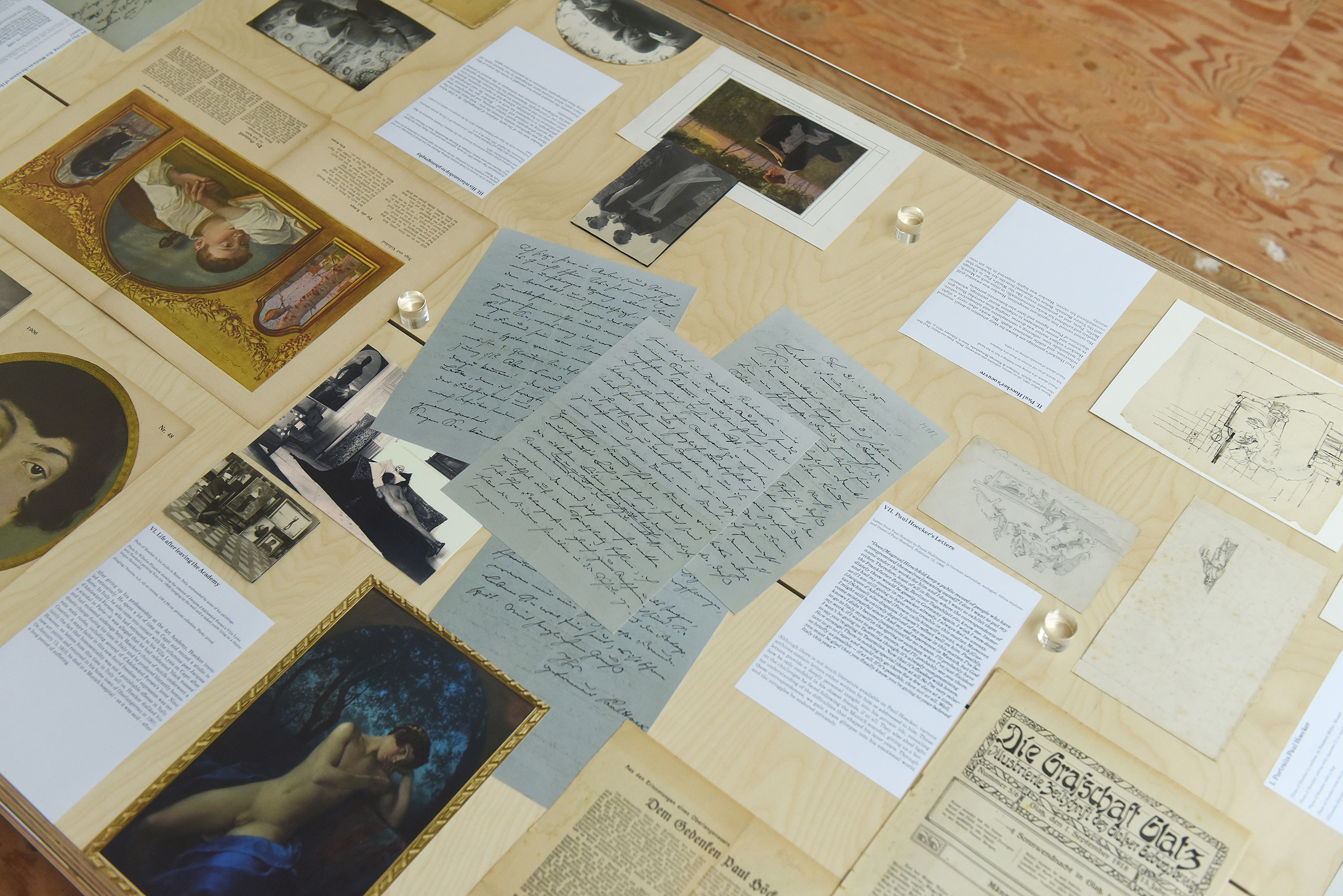
We would like to invite you to the opening of Remembering Paul by the Paul Hoecker Research Group (art historians Nicholas Maniu and Christina Spachtholz, architect Stefan Gruhne and artist Philipp Gufler) with works by Paul Hoecker and Philipp Gufler.

Throughout his life, the Munich based artist and teacher Paul Hoecker (1854-1910) has been an inspiration to artists of various generations. A founding member of the Munich Secession and a true innovator, during his professorship at the Munich Academy of Fine Arts he brought his students in contact with new movements in painting, such as Impressionism. In 1898 however, a scandal forced him to resign from this position, as he allegedly used a male sex worker as a model for his depiction of the Madonna in the painting Ave Maria. However, the true underlying reason was likely the revelation of his own homosexuality. Although he continued to be supported by his students, following his death in 1910, his work was largely forgotten. Remembering Paul is not only an ode to the artist and his work, but it also makes space for queer histories and intergenerational grieving in a wider sense.

Remembering Paul showcases letters, sketches and photographs on loan from the grassroots archive Forum Queeres Archiv München (FQAM); two prints by Philipp Gufler after a portrait by Paul Hoecker of Nino Cesarini in Capri; as well as a small interior painting by the artist and a slide show comprising all of his paintings known so far. Many of Paul Hoecker's works were lost over time, but throughout this projection, these otherwise vanished pieces find representation within an exhibition, offering them a new life and audience. Consisting of members of the FQAM, the Paul Hoecker Research Group has been tracing back the individual paintings forming his oeuvre, spanning from Dutch genre paintings to religious moral paintings, landscapes, Pierrot figures, and, after his dismissal from the academy, also more homoerotic portraits. After having been almost entirely forgotten for over a century, this show stresses the urgency to celebrate his work and legacy.


Manifold Books
Kraijenhoffstraat 34
1018RL Amsterdam

Open
Fri + Sat 1 - 5 p.m. 
and by appointment


Mourning across time – An interview with Philipp Gufler

In light of Manifold Books exhibition series The Sphinx’s Riddle, Philipp Gufler, alongside the Paul Hoecker Research Group, orchestrated an archival exhibition centering the largely forgotten figure of Paul Hoecker, a 19th-century German painter and professor, who, after a scandal related to his sexuality, was essentially exiled from art history. Sara Giannini sat down with Philipp Gufler to discuss the significance of Paul Hoecker’s legacy and the archival methodologies and strategies the research group employs in their ongoing work of queer, transgenerational remembering.

READ MORE


Photos: Lazimg or Lazoo

Mittwoch, 13. November 2024

Philipp Gufler On Screen


On Screen: Philipp Gufler


06.12.2024, 9 p.m. 

Artist talk by: Sam Steverlynck

Reserve your tickets here


The German artist Philipp Gufler (1989), who lives in Amsterdam, expresses himself using a wide range of media: from films to installations, objects, performances, publications and textile works. What connects this multiplicity of media – that are often mutually interrelated – is years of research into queer portrayals based on archival documents including legislation, police reports, newspapers or queer theory as well as oral histories, personal documents and footage from popular culture. For over a decade now, Gufler has been a member of the Forum Queeres Archiv München, an archive and study centre for the LGBTIQ+ community in Munich that also pays attention to personal or forgotten stories. Gufler himself highlights various events, places, periods and people who played a role in the micro and macro history of the queer movement: from Karl Heinrich Ulrichs (1825 - 1895), the legal expert who was a proponent of gay rights and is known as the first man to ever come out, to underground, 1980’s performance artist Rabe perplexum or the non-binary star of reality TV in the 2000s, Lana Kaiser who elicited a multitude of opinions. Elements from these films such as wardrobe items or props, not only occur in the former, but also in his installations or other spatial works. For the filmed performance Cockatoo Archive (2022) he worked with Johanna Gonschorek; both wear robes that incorporate archival items referring to, among others, the people they discuss. Bringing an archive to life as well as reflecting on the former using a variety of visual strategies including collage or superposition, are recurring elements in Gufler’s practice.


Program

Cockatoo Archive, 2022, 29 min.

Becoming-Rabe, 2016, 7 min. 

Lana Kaiser, 2020, 13 min.

Conversation with Albert Knoll, 2023, 25 min.


Further Information


Filmtheater De Uitkijk
Prinsengracht 452
Amsterdam, the Netherlands

Dienstag, 1. Oktober 2024

Blooming Archive

BLOOMING ARCHIVE


4/10/ - 03/11/2024

Opening: Thursday, 03/10/2024 at 5 p.m. 


With works by Pablo Lerma, Philipp Gufler, Tabea Nixdorff, Pauline Agustoni, Christian Friedrich, Jacquill G. Basdew and Oscar Eriksson Furunes.


This exhibition features works by seven Dutch and international artists who have researched the IHLIA – LGBTQ collection through their respective practices. Each piece is driven by a different approach of dealing with archival documents: Some of them creatively reframe archival objects to reconstruct and revitalize fragmented histories, forgotten figures, and activist strategies. Others apply montage and collage strategies based on archival holdings, highlighting questions surrounding the ordering and preserving of subaltern heritage.

Together, the works engulf a wide medial range, spanning from textiles and books to sculpture, sound, and video installation. All displays date from the last few years, reflecting the continuously growing relevance of archival art. The exhibition thus offers an insight into contemporary artistic discourses renegotiating art’s access to and participation in LGBTQIA+ history.

The motivation behind artistic research in non-heteronormative archives is not simply to extract material but also to add to the collections by way of critical inquiry and new creations. How then does archival art contribute to queer and trans heritage? By going beyond the traditional logics of archival ordering and display, archival art speculatively explores the potentials of new readings of archival records. In this regard, aesthetic sensibilities strategically recover evasive traces of intimacy and sexuality, instantiating an alternative and indirect form of archiving.

One of the central goals of the exhibition is to bring the different works and approaches into conversation, sounding out their intersecting concerns and interests in a still understudied field. Furthermore, the selection of works underscores the importance of the added value that comes from the artistic making tangible of the abundance and plentitude of queer and trans lives, routinely submerged in dominant narratives of vulnerability, loss, and death. 

Curated by Sandro Weilenmann. 


IHLIA
(3rd floor OBA Oosterdok)
Oosterdokskade 143
1011 DL Amsterdam

Free entrance
Mo-Fr: 08.00 – 22.00 hrs
Sa-Su: 10.00 – 20.00 hrs