Posts mit dem Label Amsterdam werden angezeigt. Alle Posts anzeigen

Donnerstag, 25. Juni 2026

We Carry Forward at Luther Museum


We Carry Forward

July 10 - October 11, 2026

Opening: Friday, July 10 from 5 pm (RSVP)


‘We Carry Forward’ showcases the work of eight contemporary visual artists who explore the theme of ‘queer futurity.’ In the exhibition, we question seemingly undisputed, dominant truths and make space for a multitude of perspectives, voices, and stories. How do queer lives, shaped through coded survival and collective care, produce alternative temporalities? 

Featuring work by: Yamuna Forzani, Philipp Gufler, Andrea Knezović, Ana Linhares, Katja Mater, Rory Pilgrim, Mikołaj Sobczak, and Thato Toeba. Conceptualised and curated by Andrea Knezović.


Luther Museum Amsterdam
Nieuwe Keizersgracht 570,
1018 VG Amsterdam

Opening times:
Thursday - Sunday 11 am - 5 pm


Sonntag, 8. Februar 2026

SEXUAL AESTHETICS at Martin von Zomeren


Philipp Gufler: SEXUAL AESTHETICS


March 7 - April 25, 2026

Opening: Saturday, March 7, 2026, 5 - 7 p.m.

Saturday, April 18, 4 pm
Finissage with a conversation by Viktor Neumann and Philipp Gufler


In SEXUAL AESTHETICS, three bodies of work come together: quilts, mirror paintings, and the ceramic series Sexual Aesthetics, from which the exhibition takes its title. In Gufler’s work, research and material production exist in constant exchange. The way a work is made shapes how its story unfolds, while the historical narratives he engages with thread through his choice of material. Histories become tangible, something that can be cut, stitched, looked at, mirrored, shaped, and fired. His extensive experience with archives is reflected in the meticulous way he produces his work. Archives consist of partial records, inconsistencies, and silences, and the patience required to navigate them becomes visible in his artistic process – one shaped by the endurance of slow, sustained making, and an embrace of transparency and distortion. Like textiles or clay, history is assembled over time through acts of selection and emphasis. Rather than presenting history as fixed or complete, Gufler approaches it as something continuously formed and re-formed.

Mirror paintings

The mirror works, which Gufler describes as “performative paintings,” begin with pigment. Each colour is mixed with pigments by hand. Painted one by one, colour by colour, through silkscreen onto mirrored glass. The process unfolds slowly: screen positioned, squeegee pressed, as weight is shifted across the surface, the density of colour changes with bodily pressure – even a small change in angle can create visible textures in the pigment. When two colours overlap, a third tone forms at the intersection. Seen in the center panel, as the layers build, the amount of reflection lessens and the viewer’s own image of themselves becomes partially withheld. 

Gufler situates these works in dialogue with the history of Minimalism while “queering” its austerity by reintroducing the bodily presence and self-reflection. Some works adopt a triangular form, recalling the pink triangle once used to stigmatise queer people and later reclaimed as a symbol of resistance and collective memory. The mirrored boxes are a variation on his original works, containing the reflection ever so slightly more securely with enclosed structures.

Quilts

Gufler’s work does not approach history as a purely aesthetic reference. In the quilts, his engagement with the past takes on a more explicit form. Gufler approaches quilting as a ritual structure rooted in mourning and remembrance, each quilt is dedicated to a specific figure and grows out of sustained archival research, sometimes involving weeks spent studying personal estates and image collections. He carefully selects fabrics whose textures and colours resonate with particular aspects of their lives, often highlighting overlooked or marginalised elements of their stories.

“I always try to focus on people, either who are not in the focus or... I’m able to find a new angle.”

The compositions are deliberate and carefully constructed: photographs are mirrored, cropped, or subtly altered, and texts are embedded directly into the fabric.

Working with silkscreen, a medium he has developed over nearly two decades, he builds layered textile constellations in which personal desire, political struggle, and art history intersect. For example, in the quilt dedicated to Charlotte Wolff (1897– 1986), one of the early sexual scientists active in Berlin during the Weimar Republic, Gufler reworks a historical photograph by Man Ray by mirroring it and removing the second hand, so that she appears to read with her own hand rather than someone else’s. In close contact with the surrealist artists, Wolff later turned to palm reading after her medical licence was no longer recognised in exile, continuing her research on hands in a different form.

Ceramic works

While the quilts follow a structured internal logic, the ceramic works required a different attitude and tempo. They were developed during a three-month residency at EKWC (European Ceramic Work Centre), where Gufler extended his long-standing silkscreen practice into clay. Unlike conventional ceramic silkscreen methods, where images are printed onto already finished tiles and fired at lower temperatures, he printed with coloured clay directly onto wet, still-formable surfaces. After screen printing, he further processed the surface with stamps. His first bisque firings reached around 1200°C, after which he printed again with glaze followed by further firings at approximately 1040°C. Because many of the oxides and pigments may chemically react in extreme heat, the final result could never be fully predicted; prints sometimes shifted dramatically or reappeared as faint shadows. 

The moment of opening the kiln was the first time he would see the work, often confronting something entirely different from what he has imagined. He describes how this unpredictability initially frustrated him, before he learned to accept and embrace the loss of control. 

The ceramic works can be understood as traces of an unfolding process, tiles carrying the memory of their making, holding within their surfaces the artist’s method. Over time, he developed a rhythm within this delayed process, producing more than thirty tiles during the working period in what he described as an intense, almost obsessive cycle. The imagery embedded in the ceramics stems from extensive prior archival research; many of these images relate to the archive of Magnus Hirschfeld’s Institute for Sexual Science in Berlin, an institute that was destroyed in 1933, and whose image archive was partially displaced, sold, lost, and later spread in fragments across Europe. Some materials resurfaced only as reproductions in books, with limited documentation of their origins. Long-term references of Gufler such as Cosy Pièro and Karl Heinrich Ulrichs resurface and merge with images from the sexological picture atlases of Hirschfeld from prehistory, the Middle Ages, and up to their present day. The title refers to Sexual Aesthetics by Peter Gorsen, a book that examined how ideas about sexuality have shaped artistic production, and how those ideas are themselves influenced by the social and cultural values of their time.

Text: Mabel Woodley


Hazenstraat 20
1016 SP Amsterdam
contact@gmvz.com

Gallery opening hours
Wednesday - Saturday: 13:00–18:00

Sonntag, 17. November 2024

Remembering Paul at Manifold Books, Amsterdam

Manifold Books #24
Remembering Paul
Paul Hoecker Research Group

with works by Paul Hoecker
and Philipp Gufler
21/09/'24-26/10/'24


Opening
21/09/'24, 4-6pm
location: MAP


We would like to invite you to the opening of Remembering Paul by the Paul Hoecker Research Group (art historians Nicholas Maniu and Christina Spachtholz, architect Stefan Gruhne and artist Philipp Gufler) with works by Paul Hoecker and Philipp Gufler.

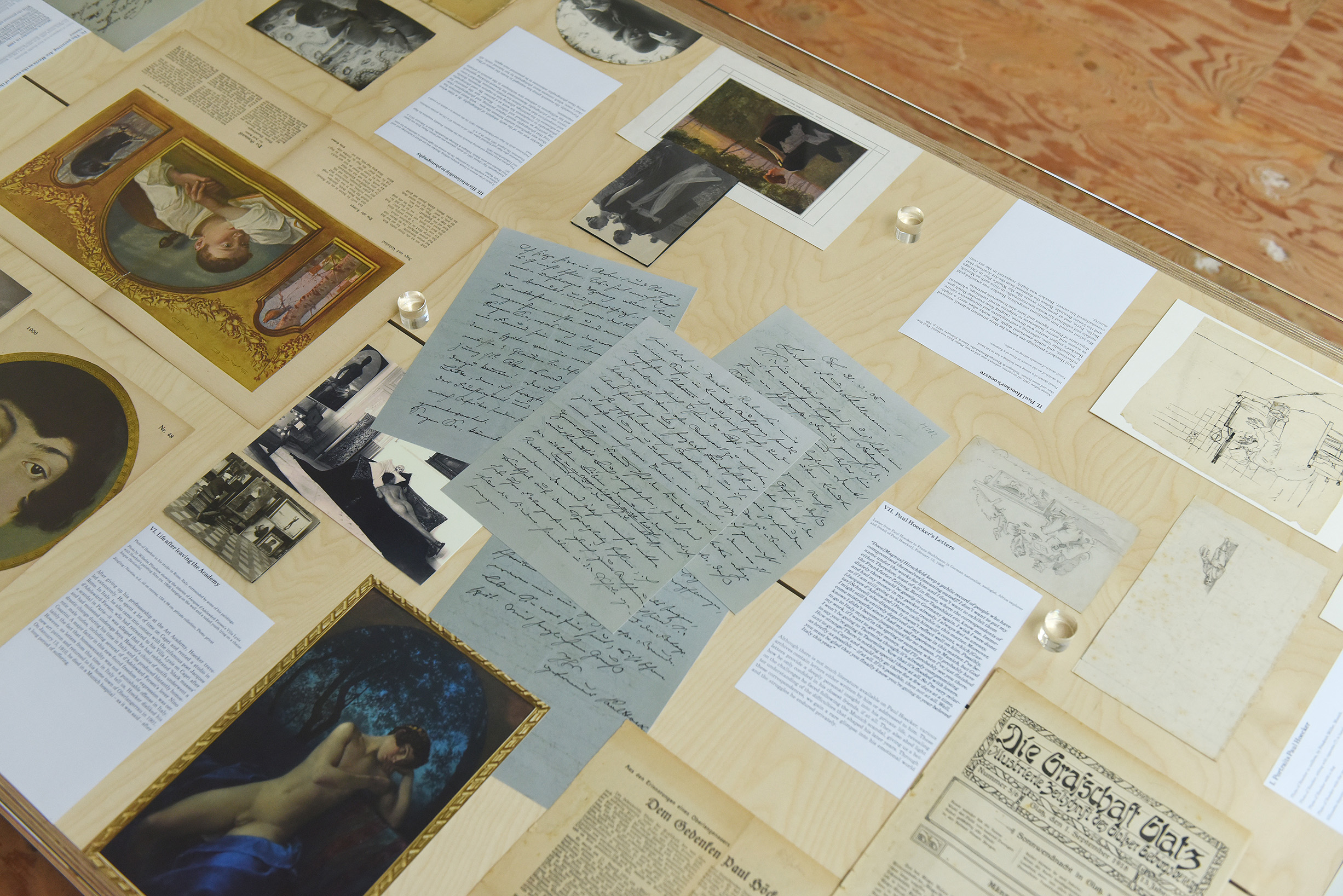
Throughout his life, the Munich based artist and teacher Paul Hoecker (1854-1910) has been an inspiration to artists of various generations. A founding member of the Munich Secession and a true innovator, during his professorship at the Munich Academy of Fine Arts he brought his students in contact with new movements in painting, such as Impressionism. In 1898 however, a scandal forced him to resign from this position, as he allegedly used a male sex worker as a model for his depiction of the Madonna in the painting Ave Maria. However, the true underlying reason was likely the revelation of his own homosexuality. Although he continued to be supported by his students, following his death in 1910, his work was largely forgotten. Remembering Paul is not only an ode to the artist and his work, but it also makes space for queer histories and intergenerational grieving in a wider sense.

Remembering Paul showcases letters, sketches and photographs on loan from the grassroots archive Forum Queeres Archiv München (FQAM); two prints by Philipp Gufler after a portrait by Paul Hoecker of Nino Cesarini in Capri; as well as a small interior painting by the artist and a slide show comprising all of his paintings known so far. Many of Paul Hoecker's works were lost over time, but throughout this projection, these otherwise vanished pieces find representation within an exhibition, offering them a new life and audience. Consisting of members of the FQAM, the Paul Hoecker Research Group has been tracing back the individual paintings forming his oeuvre, spanning from Dutch genre paintings to religious moral paintings, landscapes, Pierrot figures, and, after his dismissal from the academy, also more homoerotic portraits. After having been almost entirely forgotten for over a century, this show stresses the urgency to celebrate his work and legacy.


Manifold Books
Kraijenhoffstraat 34
1018RL Amsterdam

Open
Fri + Sat 1 - 5 p.m. 
and by appointment


Mourning across time – An interview with Philipp Gufler

In light of Manifold Books exhibition series The Sphinx’s Riddle, Philipp Gufler, alongside the Paul Hoecker Research Group, orchestrated an archival exhibition centering the largely forgotten figure of Paul Hoecker, a 19th-century German painter and professor, who, after a scandal related to his sexuality, was essentially exiled from art history. Sara Giannini sat down with Philipp Gufler to discuss the significance of Paul Hoecker’s legacy and the archival methodologies and strategies the research group employs in their ongoing work of queer, transgenerational remembering.

READ MORE


Photos: Lazimg or Lazoo

Dienstag, 1. Oktober 2024

Blooming Archive

BLOOMING ARCHIVE


4/10/ - 03/11/2024

Opening: Thursday, 03/10/2024 at 5 p.m. 


With works by Pablo Lerma, Philipp Gufler, Tabea Nixdorff, Pauline Agustoni, Christian Friedrich, Jacquill G. Basdew and Oscar Eriksson Furunes.


This exhibition features works by seven Dutch and international artists who have researched the IHLIA – LGBTQ collection through their respective practices. Each piece is driven by a different approach of dealing with archival documents: Some of them creatively reframe archival objects to reconstruct and revitalize fragmented histories, forgotten figures, and activist strategies. Others apply montage and collage strategies based on archival holdings, highlighting questions surrounding the ordering and preserving of subaltern heritage.

Together, the works engulf a wide medial range, spanning from textiles and books to sculpture, sound, and video installation. All displays date from the last few years, reflecting the continuously growing relevance of archival art. The exhibition thus offers an insight into contemporary artistic discourses renegotiating art’s access to and participation in LGBTQIA+ history.

The motivation behind artistic research in non-heteronormative archives is not simply to extract material but also to add to the collections by way of critical inquiry and new creations. How then does archival art contribute to queer and trans heritage? By going beyond the traditional logics of archival ordering and display, archival art speculatively explores the potentials of new readings of archival records. In this regard, aesthetic sensibilities strategically recover evasive traces of intimacy and sexuality, instantiating an alternative and indirect form of archiving.

One of the central goals of the exhibition is to bring the different works and approaches into conversation, sounding out their intersecting concerns and interests in a still understudied field. Furthermore, the selection of works underscores the importance of the added value that comes from the artistic making tangible of the abundance and plentitude of queer and trans lives, routinely submerged in dominant narratives of vulnerability, loss, and death. 

Curated by Sandro Weilenmann. 


IHLIA
(3rd floor OBA Oosterdok)
Oosterdokskade 143
1011 DL Amsterdam

Free entrance
Mo-Fr: 08.00 – 22.00 hrs
Sa-Su: 10.00 – 20.00 hrs

Mittwoch, 31. Mai 2023

SUBSTITUTES at W139


SUBSTITUTES

22 April - 18 June 2023
Exhibition opening: Friday, 21 April 2023 from 6 pm - 10 pm

Substitutes engages with queer history and discourses around the body, gender, and sexuality. It features artists across several generations working in a variety of mediums to contextualise and converse with these discourses. The exhibition is about the absence of bodies, the abstraction of the body, and the tools and language we use to maintain or describe our bodies—costuming, staging, masks, layering, clothing. It questions the normative frameworks that queer and functionally diverse people are subjected to. The human body is, paradoxically, both absent and present within the exhibition. 

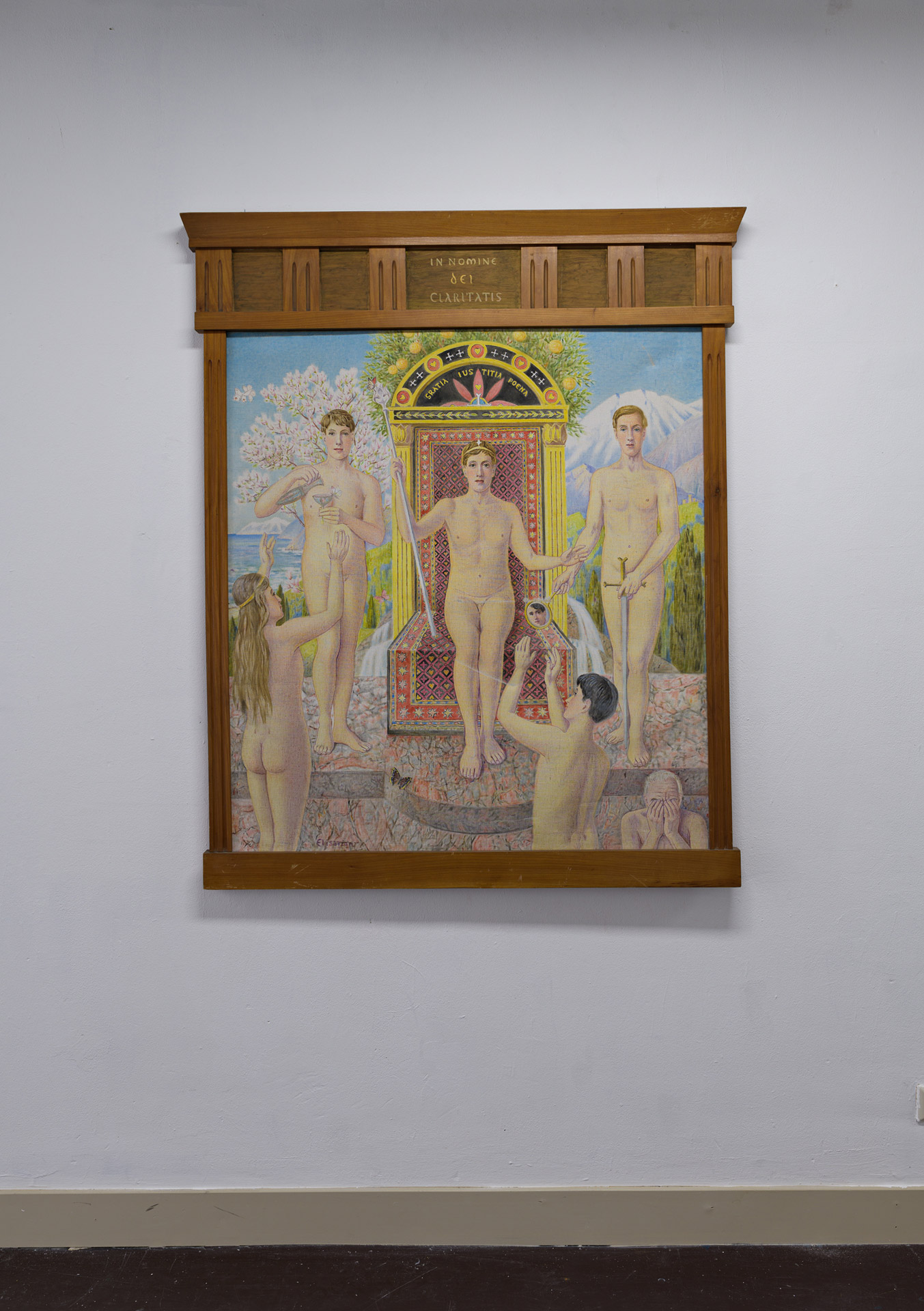
Initiated by the artist Philipp Gufler, Substitutes brings together works of Lorenza Böttner, Johanna Gonschorek, Elisàr von Kupffer, Rabe perplexum, Louwrien Wijers, Johannes Büttner, and Bruno Zhu. Philipp Gufler will show a new work titled Body/Text: a large-scale silk screen printed textile piece that draws inspiration from Elisàr von Kupffer’s panorama painting Klarwelt der Seligen (Clear World of the Blissful). By connecting contemporary discussions to historical perspectives, the exhibition aims to create a ‘living archive’. Drawing together artistic positions from then and now, the exhibition traces queer lives and networks from the past to our present. 


public programme

Keeping up with the Virus
Thursday 11 May from 20:00 to 21:00

A performance by Szymon Adamczak with Billy Mullaney exploring interdependency, connection seeking, risk-taking, and solidarity through the embodied metaphor of the virus performing in the artist’s body in the era of undetectability. Situated in relation to the unique constellation of artists gathered at W139, the performance looks to activate genealogies and dramaturgies of living with HIV across time.


Tomorrow’s Language
Saturday 3 June from 16:00 to 17:30

A dialogue between the artists Louwrien Wijers, Rory Pilgrim, and Philipp Gufler. Together they will explore Louwrien’s artworks, the significance of food, intergenerational friendships among artists, and the importance of learning from one another. Expanding on the topic of food, chef, artist and longtime collaborator of Louwrien, Egon Hanfstingl, will be preparing a saffron honey yogurt for all attendees to enjoy at the end of the event.


Guided Tour of the Exhibition
Sunday 4 June from 15:00 to 16:00

by Philipp Gufler and Tomas Adolfs.


Guided Tour of the Exhibition
Friday 9 June from 18:30 to 19:30

by Philipp Gufler and Wilfred van Buuren in collaboration with IHLIA.


Rabe perplexum and the Eccentric 80s
Friday 9 June from 20:00 to 21:30

A film screening and book presentation with Angela Stiegler and Philipp Gufler in collaboration with the Goethe Institut Amsterdam. With their performative and collaborative works, Rabe perplexum was a subversive voice of queer subculture in the 1980s. In conversation with Fabian Reichle, the artists Gufler and Stiegler will discuss artistic practices of the ‘Eccentric 80s’, their exhibition and publication of the same name, from today’s perspective.


Visual identity by Jacob Hoving.

This exhibition is generously supported by Mondriaan Fonds, Gieskes-Strijbis Fonds, Amsterdam Fonds voor de Kunst, Fonds21, Goethe Institut, Centro Elisarion, Pro Elisarion Association, Monacensia im Hildebrandhaus, Forum Queeres Archiv München and Grafisch Atelier Hilversum. 


W139
Warmoesstraat 139
1012JB Amsterdam, Nederland
Tue – Sun 12:00 – 18:00


Photos: Pieter Kiers