Posts mit dem Label Paul Hoecker research group werden angezeigt. Alle Posts anzeigen

Montag, 30. März 2026

Philipp Gufler: Imitations of Paul


1.5 - 4.7.2026

Opening: May 1, 7 p.m. 


Very few biographies leave behind a coherent, self-contained archive. Most persist primarily as traces—in images, in relationships, in what is repeated, cited, or strategically withheld. Philipp Gufler’s work begins precisely in these lacunae, integrating fragments of histor(ies) into his artistic practice. For the exhibition Imitations of Paul, he enters into dialogue with Paul Hoecker (1854–1910), a painter whose life and work were long marginalized and whose extensive oeuvre has yet to be fully catalogued. Hoecker’s career came to an abrupt end in 1898, when his homosexuality was on the verge of becoming public.

“Imitations of Paul” finds Gufler taking Hoecker’s complex biography as the point of departure for an act of artistic identification. The textile and ceramic works on view explore how new forms, images, and narratives can emerge from fragmentary archival traces. And yet imitation here is not conceived as mere replication: drawing on drag as an art form, it operates as a practice of appropriation, exaggeration, and transformation—a productive process that establishes proximity, acknowledges difference, and, through repetition, brings forth something distinctly its own.

In contrast to narratives that claim closure, Gufler’s works conceive of history as an open structure that can be extended and displaced through artistic reference. In the deliberate reprise of motifs, attitudes, and gestures, what emerges is a new proposition.

While the textile work Imitations of Paul—with its semi-transparent silkscreen prints on fabric—lends all of Hoecker’s works known to date an almost spectral presence in the gallery space, Gufler takes a new direction with the ceramic series Sexual Aesthetics. Here, images from and about Hoecker’s life intersect with art-historical and socio-historical visual references drawn from the extensive image archives associated with the sexologist Magnus Hirschfeld. The quoted motifs revolve around desire and sexuality, ranging from prehistoric cave representations to medieval and early modern art, and extending to photographs from the early twentieth century. Gufler combines Hoecker’s painting “Ave Maria”, among other works, with a woodcut depicting the torture of figures whose in some cases rapt expressions evoke less a state of suffering than an affinity with Marquis de Sade. Works like these move beyond a narrowly biographical reading to operate associatively.

A pronounced corporeality is shared by both the textile and ceramic works. The fabric installation presents Hoecker’s oeuvre as it is currently known, lending the motifs an undeniable presence despite the material’s lightness. The white fabric gathers all works identified to date through research, while the black shows those now considered lost or destroyed, as well as works whose present owners the Paul Hoecker Research Group has not yet been able to trace. For each painting, Gufler produced silkscreens at original scale through physically demanding processes. In the ceramic works, he likewise employs silkscreen printing, layering the motifs between successive firings, after which they are partially obscured by a high-gloss glaze. This deliberate interplay of concealing and revealing takes on another spatial dimension through the use of stamps, transforming the pieces into reliefs. In their emphatic materiality, the ceramic works form a tense counterpoint to the seemingly immaterial textile installation.

As a founding member of the Paul Hoecker Research Group, Gufler is directly involved in the collective research into Hoecker’s life and work. This collaborative production of knowledge forms a central backdrop to the exhibition and is exemplified in the final gallery space through a presentation of relevant archival materials. The insights developed jointly within the group are ultimately translated by Gufler into his own distinct artistic perspective. The exhibition thus unfolds within a field of tension between collective knowledge production, individual authorship, and a critical reflection on a long-marginalized artistic biography.

The exhibition is accompanied by the publication “Spuren von Paul / Traces of Paul” (Splitter 19, Forum Queeres Archiv München in collaboration with BQ, Berlin), which brings together exhibition and research as a performative collective endeavor. In the polyphony of texts and images, Paul Hoecker emerges as part of an open process of ongoing historical and artistic re-examination.


Text: Nicholas Maniu and Christina Spachtholz


BQ
Jörn Bötnagel and Yvonne Quirmbach
Weydingerstrasse 10
10178 Berlin
Tel. +49-30-23457316
info@bqberlin.de
Tue–Sat 11–18 h


Photos: Roman März

Buchpräsentation Spuren von Paul | Traces of Paul


Book launches Splitter 19: Spuren von Paul | Traces of Paul


Philipp Gufler in conversation with Stefan Gruhne, Nicholas Maniu and Christina Spachtholz (Paul Hoecker Research Group)


Spuren von | Traces of Paul 

Stefan Gruhne, Philipp Gufler, Nicholas Maniu, Christina Spachtholz (Ed.)
Forum Queeres Archiv München e.V. and BQ, Berlin
Design: Yvonne Quirmbach
with texts by Karin Althaus, Gerhard Becker, Vera Christoph, Stefan Gruhne, Philipp Gufler, Birgit Jooss, Yuliia Kizyma, Nicholas Maniu, Christina Spachtholz, Arnisa Zeqo
German/English
112 pages
14 b&w illustrations
61 coloured illustrations
20 Euro + shipping


Saturday, May 2, 2026, 3 pm
BQ

Weydingerstrasse 10
10178 Berlin

Sunday, July 19, 2026, 3 pm
Kraijenhoffstraat 34
1018RL Amsterdam

Monday, July 20, 2026, 11 am
Akademiestraße 2-4
80799 München


Donnerstag, 10. Juli 2025

Paul's House at Konteksty Festival of Ephemeral Art in Sokołowsko


Paul's House

at Konteksty Festival of Ephemeral Art in Sokołowsko, Poland

Curated by Marta Czyż 

Friday, July 18 2025, 18:30 


The performance Paul's House by Philipp Gufler explores who owns the memory and history of artist Paul Hoecker (1854–1910). After having been almost entirely forgotten for over a century, the performance stresses the urgency to celebrate his work and legacy in Poland and Germany. 


Paul Hoecker was an influential, long overlooked figure in the Munich art scene around 1900. As a painter, professor at the Academy of Fine Arts and co-founder of the Munich Secession, he was active in a phase of fundamental upheaval at the interface of tradition and modernism. After international success through his participation in the first three Venice Biennales and the World's Fair in Chicago, a scandal forced him to resign from his professorship in 1897 - caused by homophobic rumours about a painting of the Virgin Mary for which a male sex worker was the model. In the following years, he lived in self-imposed exile in Italy, on Capri and in Rome, before returning to his birthplace of Oberlangenau (now Długopole Górne) in Silesia in 1901.

Together with Stefan Gruhne, Nicholas Maniu and Christina Spachtholz, Philipp Gufler is part of the Paul Hoecker Research Group at the self-organized Forum Queeres Archiv München since 2019. One aim of the research group is to draw attention to Paul Hoecker's work and life outside Germany, particularly in his birthplace, today's Poland. Paul Hoecker immortalised his birthplace in several paintings. In April 2025, Philipp Gufler visited the Hoecker-House. 

Paul's House describes the life and work of Paul Hoecker as a shared German-Polish queer history. At the Konteksty Festival in Sokolowsko near Długopole Górne, Philipp Gufler will be showing a performance about his artistic exploration of Paul Hoecker's birthplace.


Photos: Marcela Paniak & Tomek Ogrodowczyk, Kazimierz Ździebło

Sonntag, 17. November 2024

Remembering Paul at Manifold Books, Amsterdam

Manifold Books #24
Remembering Paul
Paul Hoecker Research Group

with works by Paul Hoecker
and Philipp Gufler
21/09/'24-26/10/'24


Opening
21/09/'24, 4-6pm
location: MAP


We would like to invite you to the opening of Remembering Paul by the Paul Hoecker Research Group (art historians Nicholas Maniu and Christina Spachtholz, architect Stefan Gruhne and artist Philipp Gufler) with works by Paul Hoecker and Philipp Gufler.

Throughout his life, the Munich based artist and teacher Paul Hoecker (1854-1910) has been an inspiration to artists of various generations. A founding member of the Munich Secession and a true innovator, during his professorship at the Munich Academy of Fine Arts he brought his students in contact with new movements in painting, such as Impressionism. In 1898 however, a scandal forced him to resign from this position, as he allegedly used a male sex worker as a model for his depiction of the Madonna in the painting Ave Maria. However, the true underlying reason was likely the revelation of his own homosexuality. Although he continued to be supported by his students, following his death in 1910, his work was largely forgotten. Remembering Paul is not only an ode to the artist and his work, but it also makes space for queer histories and intergenerational grieving in a wider sense.

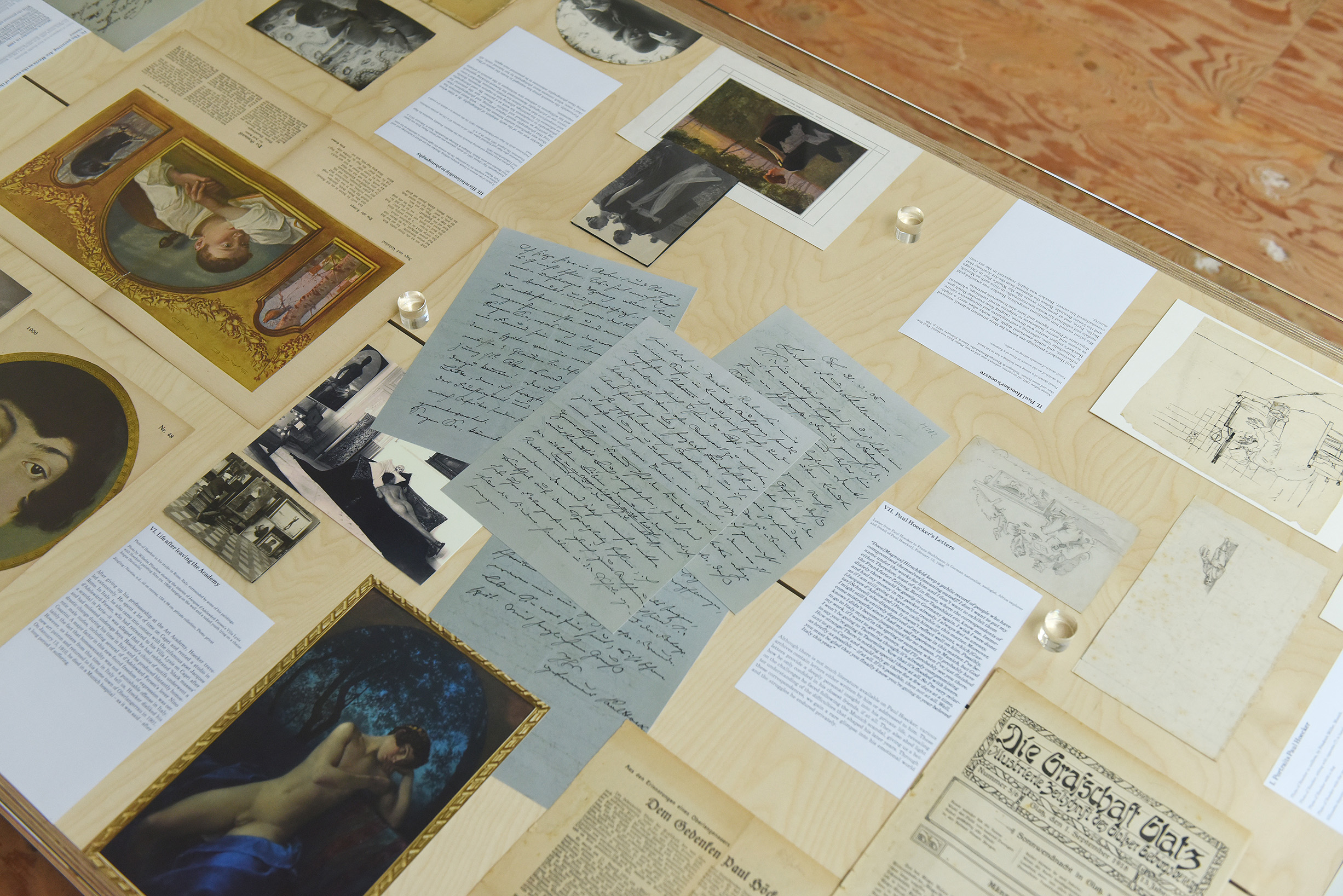
Remembering Paul showcases letters, sketches and photographs on loan from the grassroots archive Forum Queeres Archiv München (FQAM); two prints by Philipp Gufler after a portrait by Paul Hoecker of Nino Cesarini in Capri; as well as a small interior painting by the artist and a slide show comprising all of his paintings known so far. Many of Paul Hoecker's works were lost over time, but throughout this projection, these otherwise vanished pieces find representation within an exhibition, offering them a new life and audience. Consisting of members of the FQAM, the Paul Hoecker Research Group has been tracing back the individual paintings forming his oeuvre, spanning from Dutch genre paintings to religious moral paintings, landscapes, Pierrot figures, and, after his dismissal from the academy, also more homoerotic portraits. After having been almost entirely forgotten for over a century, this show stresses the urgency to celebrate his work and legacy.


Manifold Books
Kraijenhoffstraat 34
1018RL Amsterdam

Open
Fri + Sat 1 - 5 p.m. 
and by appointment


Mourning across time – An interview with Philipp Gufler

In light of Manifold Books exhibition series The Sphinx’s Riddle, Philipp Gufler, alongside the Paul Hoecker Research Group, orchestrated an archival exhibition centering the largely forgotten figure of Paul Hoecker, a 19th-century German painter and professor, who, after a scandal related to his sexuality, was essentially exiled from art history. Sara Giannini sat down with Philipp Gufler to discuss the significance of Paul Hoecker’s legacy and the archival methodologies and strategies the research group employs in their ongoing work of queer, transgenerational remembering.

READ MORE


Photos: Lazimg or Lazoo