Poster by Philipp Gufler, special thanks to Yvonne Quirmbach!
Posts mit dem Label Een Gebeuren werden angezeigt. Alle Posts anzeigen
Montag, 25. März 2019
Movie poster, 2019
Poster by Philipp Gufler, special thanks to Yvonne Quirmbach!
Montag, 15. Oktober 2018
Fotografie der Performance
Burcu Dogramaci
Fotografie der Performance
Live Art im Zeitalter ihrer Reproduzierbarkeit235 Seiten, 67 s/w Abb., kart.
ISBN: 978-3-7705-6383-8
Montag, 27. Februar 2017
Romankreisen
Philipp Gufler "Romankreisen"
Opening: Friday 24.3.201720 H: Reading by Fantasma and Philipp Gufler from his book “Indirekte Berührung”
Exhibition: 25.3. - 15.4.2017
"The whole novel touches its own page bottom and turns to the next page" Hubert Fichte on his literary project "Die Geschichte der Empfindlichkeit"
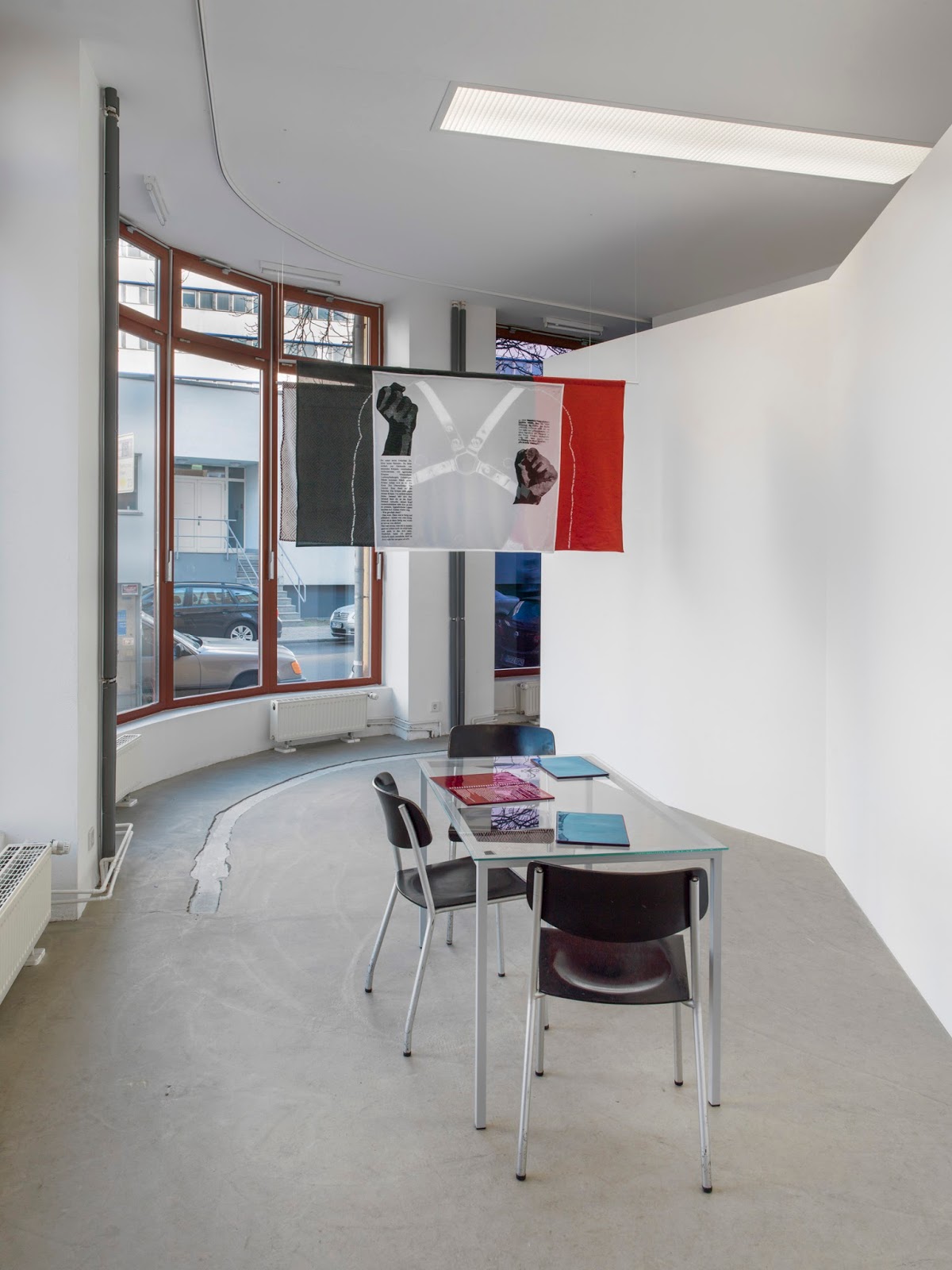
The title of Philipp Gufler’s first show at BQ borrows a term from the German novelist and ethnographer Hubert Fichte (1935 – 1986). Fichte associated this literal translation from Greek with the concept of a circular novel, which in its course returns to the point of departure. In his show, Gufler adapts Fichte’s thought as the conceptual idea of an abstract, orbital movement to reflect on exemplary themes, methods and forms that feature in his body of work. The artist book Indirekte Berührung / Indirect Contact forms the central piece of the exhibition and relates its elements in the form of a logbook. The installation includes mirrors that have been transformed with transparent colour pigments as well as layered fabrics with varying prints. These quilts are hung in the space and also constitute a separate space within the gallery. The last element is an acrylic glass showcase onto which the documentation of a previous performance is projected.
Making use of screen-printing on blue and pink plastic film with spiral binding (a technique which features prominently in his works), Gufler’s prose also takes a shape in which enables its haptic qualities to be experienced. Within these pieces, the reader encounters different characters, some of whom have inspired and influenced Gufler’s artistic production for a long time. They all position themselves on a fictional time scale, stretching from 1597 – the year in which the early baroque painter Caravaggio supposedly started work on his Narcissus – up to 2075 – the future year in which the performance een gebeueren, enacted in 1975 by the Dutch artist Ben d’Armagnac (1940 – 1978), will see its 100th anniversary. Besides locating these two artistic positions that are of personal relevance for Gufler, the years also serve as markers for a wide spectrum of reference points in his works that are often based on artistic research. All major characters – researchers, writers and artists alike – share a fundamentally critical attitude towards the norms of their time, putting into question cultural, political and sexual identity.
Indirect Touch allows historic figures and contemporaries of Gufler to meet outside the boundaries of chronological order. Gufler gives them an indirect voice in the form of appropriated fragments (which cannot be identified as citations in all cases). However, he does not merely cite or reproduce these characters but rather condenses the attitudes associated with or expressed by them. In the process of indirect writing, Gufler repeatedly seems to merge with his characters. The persona that links all 21 chapters is Jäcki, based on the gay flaneur and writer-protagonist from Hubert Fichte’s novel Palette (1968). Like Fichte, Gufler makes use of the character Jäcki as screen as well as ambivalent Doppelgänger (who never fully becomes the alter ego). The character Jäcki becomes a medium for repeated autobiographical passages that may be subtly woven into the text but may also dominate whole chapters.
Gufler’s literary and artistic self-assessments are indirect yet at the same time true to the principle ‘Put your self in quotation marks – call yourself a novel ’. The Fichte quote from Versuch über die Pubertät (1974), parts of which Gufler previously used in an exhibition title, illustrates a decidedly self-critical distance towards an up-close autobiographical approach. That same principle also governs Gufler’s installations and performances. His approaches to a choice of characters from a long tradition of emancipatory history are marked by the artistic pursuit of deeper involvement in regards to emotions and content. Gufler temporarily merges with his subjects of study and, in doing so, self-referentially reveals a fundamental difference between those subjects and himself.
Philipp Fürnkäs
BQ
Weydingerstraße 10
10178 Berlin
![]() |
| Philipp Gufler, Romankreisen, 2017 Silkscreen on fabric, 4-parts 208,5 x 216 x 216 cm |
![]() |
| Een gebeuren, 2016 Video: 28:33 min., acrylic glass box, fly maggots, books, scraper, blades, key, lamp, projector, speakers, media player Acrylic glass box: 99,7 x 204,8 x 89 cm, projektion variable |
| Reading by Fantasma and Philipp Gufler from his book Indirekte Berührung during the opening |
| Philipp Gufler, Indirekte Berührung, 2017 Silkscreen on foil, spiral bound, 30,4 x 19,5 cm Edition 100 (German), Edition 100 (English |
Photo: Roman März, Berlin
Courtesy BQ, Berlin
Freitag, 12. August 2016
Een Gebeuren, Ausstellung in der Gallerie Françoise Heitsch, München
PHILIPP GUFLER:
Een Gebeuren
09.09.2016 - 29.10.2016
Open Art-Eröffnung, Freitag, 9. September, 18 Uhr
Françoise Heitsch
Amalienstraße 19
80333 München
Open: MI - FR 14 - 19 Uhr
Sa 12 - 17 Uhr
fheitsch (at) francoiseheitsch.de
www.francoiseheitsch.de
https://www.facebook.com/GalerieFrancoiseHeitsch/
Pressetext von Patrizia Dander (PDF)
Press release by Patrizia Dander (PDF)
![]() |
Labels:
Ben d'Armagnac,
Een Gebeuren,
Françoise Heitsch,
München,
Munich,
Performance,
Quilts
Montag, 6. Juni 2016
Setze dein Ich in Anführungsstriche, Kunstverein Göttingen
Philipp
Gufler
19.06. – 31.07. 2016
Setz dein Ich in Anführungsstriche
Mit »Setz dein Ich in Anführungsstriche« präsentiert der Kunstverein
Göttingen Philipp Guflers erste institutionelle Einzelausstellung. Der
Titel bezieht sich auf Hubert Fichtes »Versuch über die Pubertät«
(1974), der mit den Worten »Setz doch dein Ich in Anführungsstriche –
nenn dich ›Roman‹« seiner literarischen Annäherung auch eine analytische
Distanz zur Seite stellte, um die eigene (zum Teil autobiografische)
Herangehensweise infrage zu stellen. Mit einer ähnlichen Geste nähert
sich Philipp Gufler den Inhalten der Ausstellung an: Guflers Arbeiten
beschäftigen sich unter anderem mit zwei künstlerischen Positionen der
70er und 80er Jahre – Rabe Perplexum in München und Ben d’Armagnac in
den Niederlanden – deren Performances und künstlerisches Werk heute nur
in Bruchstücken rezipiert werden können. Es ist ein persönlicher Zugang,
der trotz großer Nähe eine künstlerische Distanz wahrt; eine
Überlagerung, ohne dass sich die eigene Künstleridentität in den Sujets
auflöst.
Die Annäherung an die beiden Positionen erfolgt bei Gufler nicht nach kunsthistorischen Regeln oder durch Reenactments, stattdessen versucht er eine Art künstlerische Dopplung zu schaffen. Es geht ihm nicht um das (Wieder-)Auf- führen der Performances, sondern darum, mit den Mitteln der eigenen künstlerischen Praxis die Persona hinter der Performance auszuloten. »Becoming-Rabe« heißt eine Videoinstallation, in der Gufler die Rolle der Künstlerin Rabe Perplexum übernimmt. Die resultierende Verschmelzung der Identitäten passiert nicht linear, sondern durch eine poetische Mimesis, die durch Archivaufnahmen und Rabes Performance-Requisiten aufgebaut wird.
Das Motiv der Dopplung oder Überlagerung zieht sich wie ein roter Faden durch den Ausstellungsraum. Durch das Zusammenbringen verschiedener Ebenen, sowohl visueller als auch zeitlicher und identitärer, bricht Gufler mit einem üblichen (wissenschaftlichen) Geschichtsverständnis. Indem er die beiden Künstleridentitäten nicht als abgeschlossene, historische Entitäten betrachtet, kann er diese fortschreiben, um- ändern oder neu anordnen. Philipp Gufler produziert keine identitäre Festschreibung, sondern verwischt die Grenzen zwischen dem künstlerischen Selbst und dem Sujet – eine Geste, die in einer Serie von Quilts wieder aufgegriffen wird und die sich für die BetrachterInnen auch in einer Reihe an Siebdrucken auf Spiegeln entwickelt.
»Schwule Sprache ist uneigentlich, ist indirekte Sprache«, schrieb Fichte über Henry James, sie arbeite mit »Soussentendus, Verfremdungen, Übertreibungen, Ironie, Travestie«. Gufler greift diese Stilmittel in seinen Arbeiten auf. Dabei wird er nicht zu einem »Für-Sprecher«, sondern im Gegenteil zu einem Sprecher, der mit den anderen zusammen spricht. Er formuliert Andeutungen, die einen Raum für das Werk Rabes und D’Armagnacs schaffen, und er verfremdet diesen Raum, um mit der eigenen Sprache die Idee einer Künstleridentität zu destabilisieren.
////////////////////////////
»Setz dein Ich in Anführungsstriche« (Put your I in quotation marks) is Philipp Gufler's first institutional solo show. The title references Hubert Fichte's "Essay on puberty" (1974) with the excerpt, "Just put your I in quotation marks – call yourself a ‘novel’", which adds an analytical distance to his otherwise literary advancements in order to question his own (partly autobiographical) approach. Philipp Gufler appropriates a similar gesture when handling the exhibition content: The work deals with two artistic positions from the 1970's and 80's – Rabe Perplexum in Munich and Ben d'Armagnac in Holland, whose performances and artistic oeuvre can nowadays only be perceived fragmentarily. It is a personal technique, which through its immediacy still manages to preserve an artistic distance; a layering, without losing the artistic identity of its subjects.
The method Gufler applies does not follow art historical norms nor make use of reenactments, instead he attempts to create a kind of artistic doubling. His interest lies not in the repetition of a performance, rather he uses his own artistic praxis to sound out the persona behind the performance. "Becoming-Rabe" is a video installation in which Gufler takes on the role of artist Rabe Perplexum, wherein the resulting identity-merge does not occur on a linear basis, but through poetic mimesis using archival footage and Rabe's performance props.
The motive of doubling and layering is a common denominator throughout Gufler's exhibition. The merging of layers, visual as well as temporal and identitarian, manages to break with the common (scientific) understanding of history. Gufler's disregard of artistic identities as finalized, historical entities allows him the freedom to update, change and realign these. His work is not a production of identitarian fixation, but instead blurs the borders between the artist's self and the subject – a gesture which is also reflected in his series of quilts and elaborated on for the viewer in a sequence of silkscreened mirrors. The resulting reflections within the space add an additional layer to the exhibition's conceptual discourse.
Fichte wrote of Henry James that, "Gay language is inauthentic, it is a form of indirect speech", consisting of "innuendoes, alienation, exaggerations, irony, travesty". Gufler appropriates these stylistic devices, speaking with them, not for them. Gufler's individual language of intimations creates a space for the work of Rabe and D'Armagnac, whilst at the same time defamiliarizing it, in order to ultimately destabilize any form of artistic identity.
Kuratiert von Anja Lückenkemper
37073 Göttingen
ÖFFNUNGSZEITEN
Die Annäherung an die beiden Positionen erfolgt bei Gufler nicht nach kunsthistorischen Regeln oder durch Reenactments, stattdessen versucht er eine Art künstlerische Dopplung zu schaffen. Es geht ihm nicht um das (Wieder-)Auf- führen der Performances, sondern darum, mit den Mitteln der eigenen künstlerischen Praxis die Persona hinter der Performance auszuloten. »Becoming-Rabe« heißt eine Videoinstallation, in der Gufler die Rolle der Künstlerin Rabe Perplexum übernimmt. Die resultierende Verschmelzung der Identitäten passiert nicht linear, sondern durch eine poetische Mimesis, die durch Archivaufnahmen und Rabes Performance-Requisiten aufgebaut wird.
Das Motiv der Dopplung oder Überlagerung zieht sich wie ein roter Faden durch den Ausstellungsraum. Durch das Zusammenbringen verschiedener Ebenen, sowohl visueller als auch zeitlicher und identitärer, bricht Gufler mit einem üblichen (wissenschaftlichen) Geschichtsverständnis. Indem er die beiden Künstleridentitäten nicht als abgeschlossene, historische Entitäten betrachtet, kann er diese fortschreiben, um- ändern oder neu anordnen. Philipp Gufler produziert keine identitäre Festschreibung, sondern verwischt die Grenzen zwischen dem künstlerischen Selbst und dem Sujet – eine Geste, die in einer Serie von Quilts wieder aufgegriffen wird und die sich für die BetrachterInnen auch in einer Reihe an Siebdrucken auf Spiegeln entwickelt.
»Schwule Sprache ist uneigentlich, ist indirekte Sprache«, schrieb Fichte über Henry James, sie arbeite mit »Soussentendus, Verfremdungen, Übertreibungen, Ironie, Travestie«. Gufler greift diese Stilmittel in seinen Arbeiten auf. Dabei wird er nicht zu einem »Für-Sprecher«, sondern im Gegenteil zu einem Sprecher, der mit den anderen zusammen spricht. Er formuliert Andeutungen, die einen Raum für das Werk Rabes und D’Armagnacs schaffen, und er verfremdet diesen Raum, um mit der eigenen Sprache die Idee einer Künstleridentität zu destabilisieren.
////////////////////////////
»Setz dein Ich in Anführungsstriche« (Put your I in quotation marks) is Philipp Gufler's first institutional solo show. The title references Hubert Fichte's "Essay on puberty" (1974) with the excerpt, "Just put your I in quotation marks – call yourself a ‘novel’", which adds an analytical distance to his otherwise literary advancements in order to question his own (partly autobiographical) approach. Philipp Gufler appropriates a similar gesture when handling the exhibition content: The work deals with two artistic positions from the 1970's and 80's – Rabe Perplexum in Munich and Ben d'Armagnac in Holland, whose performances and artistic oeuvre can nowadays only be perceived fragmentarily. It is a personal technique, which through its immediacy still manages to preserve an artistic distance; a layering, without losing the artistic identity of its subjects.
The method Gufler applies does not follow art historical norms nor make use of reenactments, instead he attempts to create a kind of artistic doubling. His interest lies not in the repetition of a performance, rather he uses his own artistic praxis to sound out the persona behind the performance. "Becoming-Rabe" is a video installation in which Gufler takes on the role of artist Rabe Perplexum, wherein the resulting identity-merge does not occur on a linear basis, but through poetic mimesis using archival footage and Rabe's performance props.
The motive of doubling and layering is a common denominator throughout Gufler's exhibition. The merging of layers, visual as well as temporal and identitarian, manages to break with the common (scientific) understanding of history. Gufler's disregard of artistic identities as finalized, historical entities allows him the freedom to update, change and realign these. His work is not a production of identitarian fixation, but instead blurs the borders between the artist's self and the subject – a gesture which is also reflected in his series of quilts and elaborated on for the viewer in a sequence of silkscreened mirrors. The resulting reflections within the space add an additional layer to the exhibition's conceptual discourse.
Fichte wrote of Henry James that, "Gay language is inauthentic, it is a form of indirect speech", consisting of "innuendoes, alienation, exaggerations, irony, travesty". Gufler appropriates these stylistic devices, speaking with them, not for them. Gufler's individual language of intimations creates a space for the work of Rabe and D'Armagnac, whilst at the same time defamiliarizing it, in order to ultimately destabilize any form of artistic identity.
Kuratiert von Anja Lückenkemper
KUNSTVEREIN GÖTTINGEN
im Künstlerhaus
Gotmarstraße 137073 Göttingen
Di-Fr 14-18 Uhr, Sa/So 11-17 Uhr
VERNISSAGE
So, 19. Juni 2016, 11.30 Uhr
Freitag, 15. April 2016
Uitnodiging: opening tentoonstelling Untitled (two takes on crisis)
Opening Untitled (two takes on crisis)
Tentoonstelling 23 april – 12 juni 2016
Opening vrijdag 22 april 14 – 21 uur
Locatie: de Appel arts centre, Prins Hendrikkade 142, Amsterdam
De Appel arts centre en de deelnemers van het Curatorial programme nodigen je van harte uit voor de openingsdag van het eindproject van het Curatorial programme 2015-16: Untitled (two takes on crisis) op vrijdag 22 april van 14 – 21 uur.
De deelnemers van het Curatorial Programme presenteren twee projecten, getiteld You Must Make Your Death Public en Rien ne va plus? Faites vos jeux! waarin een verscheidenheid aan ideeën, strategieën en tegenzetten zijn samengebracht, die worden gebruikt in situaties waarin een diepgaande verandering plaatsvindt.
During the exhibition I'm organising three evenings:
Thursday 5th of May, 5pm
Een gebeuren #01
Talk with Philipp Gufler and Louwrien Wijers on Ben d'Armagnac, Presentation of "Quilt #12 (Ben d'Armagnac)"
more
Thursday 19th of May, 5pm
Een gebeuren #02
Magazine presentation of FLORIDA #02 with Lothringer13_Florida and film screening of two films by Margaret Raspé. Philipp Gufler in discussion with Maximiliane Baumgartner and Colin Djukic from Florida.
Thursday 2nd of June, 5-7pm
Een gebeuren #03
Performance by Philipp Gufler. By revising and adjoining on Ben d'Armagnac's performance at 1975 in De Appel Art Centre, he wants to embody the perspective from inside the cube and project the d'Armagnac's performance into the future.
more
Photos: Cassander Eeftinck Schattenkerk, De Apple art center
Labels:
Amsterdam,
Becoming-Rabe,
Ben d'Armagnac,
De Appel,
Een Gebeuren,
Mirror,
Quilts,
Rabe Perplexum
Abonnieren
Posts (Atom)